
Origination Lift
Most NBFC funnels leak value before the final credit decision. Eligibility invites and soft offers are often driven by blunt score rules that quietly screen out borrowers who would have performed well. This chapter treats origination lift as a governed, credit‑led practice: improving front‑door yield and conversion while keeping early‑vintage behaviour inside guardrails.
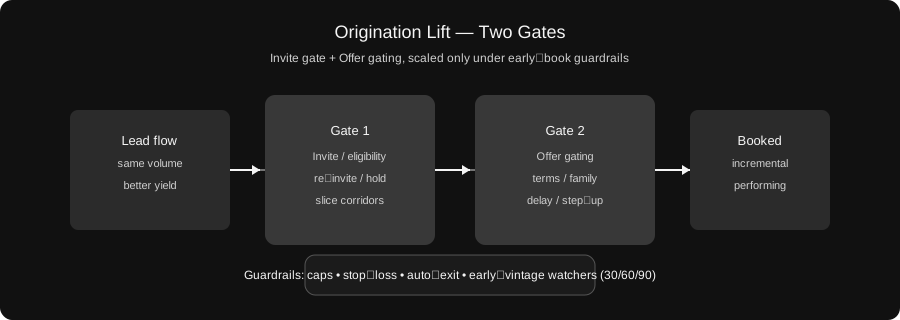
Two gates, one discipline: improve invites and offer gating using portfolio feedback—then scale only when early-book health stays within limits.
What we mean by origination lift
Origination lift is not “more leads”. It is more booked, performing accounts from the same lead flow, achieved by refining who gets invited, what offer is placed, and how fast a corridor is scaled. The promise is narrow on purpose: lift must show up in verified booking outcomes and early‑vintage signals, not in vanity funnel metrics.
Where lift is lost in typical funnels
Most institutions already run a strong predictive baseline. The leakage happens upstream: eligibility thresholds, policy exclusions, and one‑size‑fits‑all offer rules. These are efficient, but blunt.
The result is a quiet pile of “could‑have‑been good” customers who never reach the approval gate—or reach it only on terms that discourage uptake.
The two gates you actually control
Think of origination as two gates:
- Pre‑approval / invite gate — who is allowed to proceed to a serious offer.
- Approval / booking gate — who is booked, and on what terms.
Origination Lift improves the first gate and the handoff to the second. False Negative Revival focuses on the final gate itself. Used together, they reduce leakage without relaxing discipline.
What we adjust
We adjust a small set of levers—always under declared limits:
- Eligibility invites: when to invite, re‑invite, or hold back a segment.
- Offer gating: which offer family is appropriate (or whether to delay an offer).
- Corridor capacity: how much volume is allowed to scale in each slice (branch, cohort, product).
We do not optimise media spend, creatives, or channels. The focus is credit‑led conversion inside the origination funnel.
Guardrails and rollout doctrine
Lift is earned, not assumed. Rollout follows a simple staircase: pilot → expand → standardise. Guardrails include caps, stop‑loss triggers, and auto‑exit conditions when early‑vintage health deviates.
This protects the book while allowing learning to travel—carefully—across branches and cohorts.
How we prove it moved the book
Proof is measured in outcomes leadership recognises:
- Incremental booked accounts and incremental disbursal value within target slices.
- Early‑vintage watchers (first 30/60/90 days): delinquency drift, bounce patterns, and stress signals.
- Value Ledger accounting to avoid double counting across approvals, pricing, and collections.
The goal is a result a risk head can sign off on: higher yield with unchanged (or improved) early‑book behaviour.
If you only have twenty minutes
- Origination lift means more booked, performing loans from the same lead flow.
- We work on the invite gate and offer gating, not marketing spend.
- All changes are guardrailed and scaled only when early‑vintage signals stay healthy.
- Impact is booked into the Value Ledger so claims remain conservative and attributable.
FAQ
Is this the same as marketing optimisation?
What if our baseline model is already strong?
How do you prevent ‘lift’ from becoming hidden risk?
Key terms in this chapter
- Origination Lift
- Verified improvement in booking yield and conversion within the origination funnel, achieved under guardrails.
- Invite Gate
- The eligibility boundary that determines who receives a serious offer or is allowed to proceed.
- Offer Gating
- Rules and policies that determine which offer (or delay) is placed for a given slice.
- Early‑Vintage Watchers
- First 30/60/90‑day signals used to scale or roll back corridors before loss emerges.