
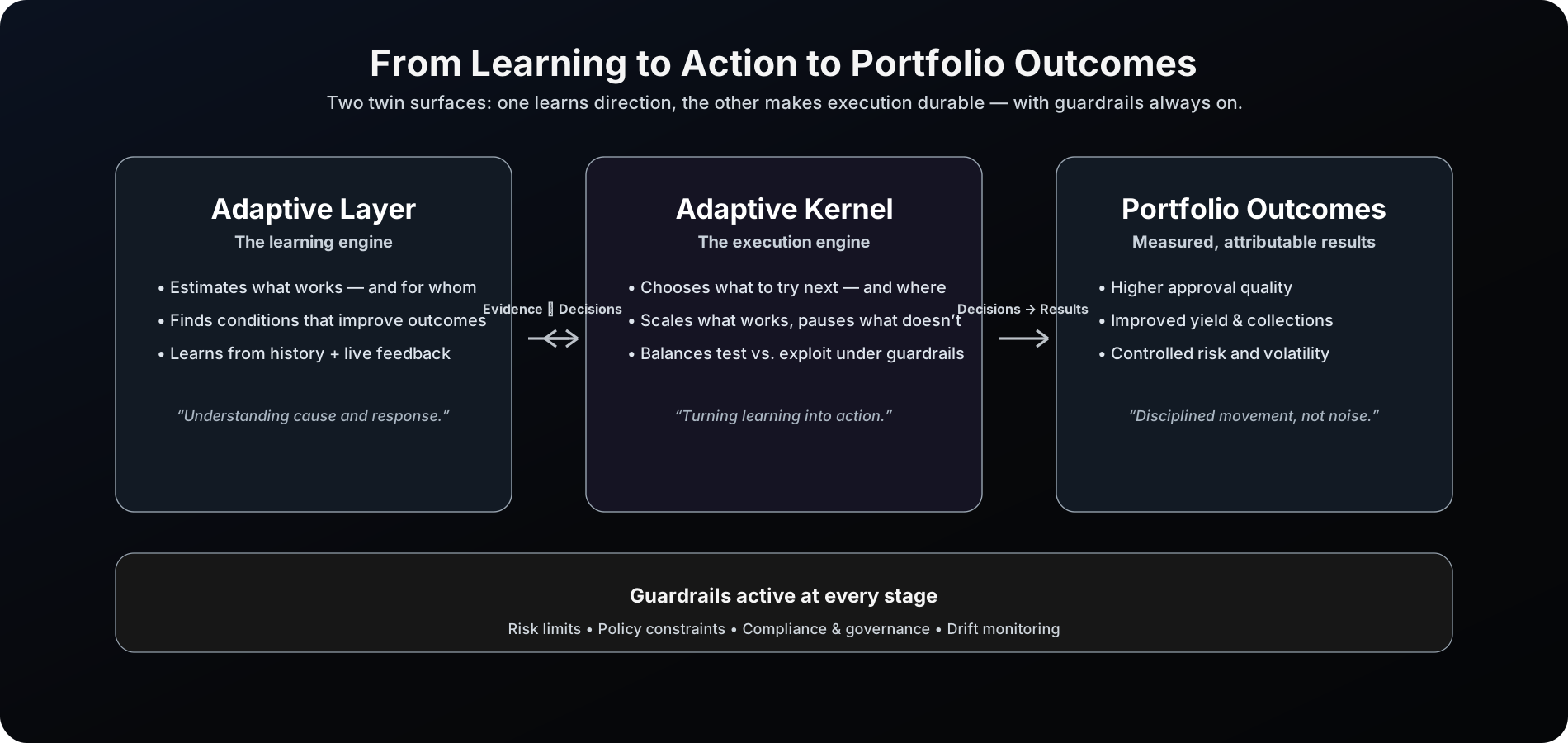
Adaptive Layer
The Adaptive Layer is the learning engine that sits behind all the other chapters in this notebook. It does not decide policy by itself. Instead, it remembers what you tried, how those decisions behaved through time and stress, and which combinations of levers quietly moved the economics of the book.
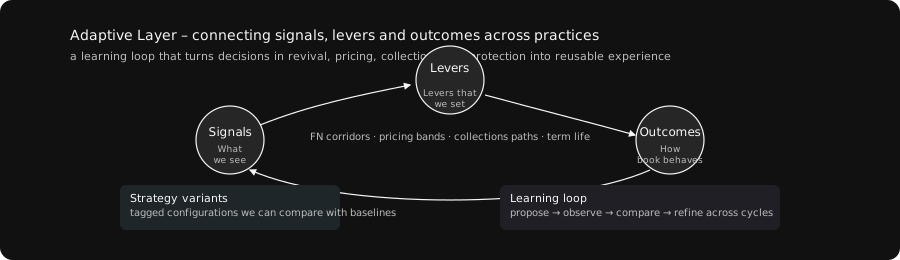
The Adaptive Layer is a living loop: decisions → outcomes → learning → updated guardrails, without breaking governance.
Why an adaptive layer is needed
Most institutions already have data, models and dashboards. What they often lack is a disciplined way to connect individual decisions to long-run outcomes. Revival corridors are opened and closed, price bands are nudged, collection scripts are changed, term life bundles are tweaked – but the memory of these moves lives in people, not in a shared learning system.
The Adaptive Layer exists to change that. It treats operational decisions as hypotheses: explicit statements about who you are willing to lend to, on what terms, under which stress view, with what expected behaviour. It then tracks how those hypotheses perform and feeds that experience back into the next round of design.
In that sense, the Adaptive Layer is less a piece of technology and more a habit: the habit of asking “What did we expect this move to do?” and “What did it actually do?” in a form that is reusable.
Signals, levers and outcomes
At its core, the Adaptive Layer works with three families of objects:
- Signals – what the institution observes at decision time: applicant characteristics, portfolio state, stress zone, competitive posture and any operational constraints.
- Levers – the configurable choices it makes in response: corridor definitions, price band positions, collections paths, term life premium and benefit settings.
- Outcomes – how borrowers and portfolios behave subsequently: approvals and take-up, delinquency, cure, prepayment, claim experience, complaints and contribution to income and capital.
The Adaptive Layer stitches these together. It does not forget that a particular cohort originated through a certain corridor at a certain price point under a particular stress view. When that cohort later goes through collections or claims, the trail remains intact.
From one-off experiments to a learning rhythm
Many lenders run experiments – a pilot in one geography, a temporary change in score cut-off, a new collections script. The difficulty is not running pilots; it is absorbing what they taught into the main practice without losing nuance.
The Adaptive Layer turns experiments into a rhythm:
- New moves in revival, pricing, collections or insurance are tagged as distinct strategies with clear start conditions and intended effects.
- Their cohorts are tracked separately over time, even after the pilot window has closed.
- Results are compared not just with raw averages but with realistic baselines: what would have happened with prior strategies under similar signals and stress.
This rhythm means that learning does not depend on a few individuals remembering “what we tried last year” when they are under pressure. It is embedded in the way the book is read.
How the Adaptive Layer and Adaptive Kernel talk to the other chapters
Think of the Adaptive Layer as the sense-making surface and the Adaptive Kernel as the action surface. Together, they connect the rest of the site: pricing, revival, collections, stress navigation, and the Value Ledger. The Layer supplies evidence and conditions; the Kernel supplies sequencing and controlled rollout; the Ledger supplies attribution.
- In False Negative Revival, it learns which corridor designs and quality gates produce revived cohorts that behave like good-book borrowers – and which designs quietly drift.
- In Rates & Pricing Dynamics, it observes how volume, mix and behaviour change as you move within bands and across stress zones.
- In Collections Lift, it recognises which response paths work best for different frictions and how those paths need to adjust when conditions tighten.
- In Insurance Pricing – Term Life, it connects premiums, benefits and communication to persistency, claims experience and the health of the lending relationship.
- In Stress Navigation, it reads how the book actually behaves in comfort, watch and action zones and helps refine the thresholds that define those zones.
The output is not a grand algorithm. It is a set of quietly improving recommendations and guardrail checks that make each chapter more precise over time.
Guardrails and appetite in a learning system
An adaptive system without guardrails is just volatility with better vocabulary. Guardrails define appetite: where experimentation is allowed, what must never move, and how fast policy can change. The Adaptive Kernel is where these limits become real — caps, throttles, and stop-rules — so learning never outruns governance.
In practice this means:
- Each new strategy has explicit limits: which segments it applies to, how much volume or exposure it is allowed to touch, and what triggers an automatic review or pause.
- The Stress Navigation map defines the context: certain strategies are only active in comfort or watch zones, not in action zones.
- A small group – typically across Risk, Business and Finance – owns the catalogue of strategies and the logic for scaling, reshaping or retiring them.
This keeps adaptation honest. The institution learns faster where it can afford to learn, and slows down where stability matters more than experimentation.
Signals of a healthy adaptive practice
A healthy Adaptive Layer leaves fingerprints in how the organisation talks about its book. You begin to hear questions such as:
- “What did we learn from the last time we relaxed this cut-off in these three cities?”
- “Which revival corridors survived the last stress episode, and why?”
- “Where has price elasticity proved strongest, and how did those cohorts behave in collections?”
- “What did our term life customers experience during the last wave of claims, and how did that feed back into our lending relationships?”
Over time, the conversation shifts from “what is happening to us?” to “what did we cause, and was it worth it?”. That shift is the Adaptive Layer doing its work.
Data, models and human judgement
The Adaptive Layer will often use advanced models to detect patterns, relate signals to outcomes and propose new configurations of levers. But the point of the practice is not to outsource judgement. It is to give judgement a clearer, better-organised evidence base.
- Models suggest where corridors, bands and paths might be missing opportunity or carrying hidden risk.
- Human teams decide which suggestions align with strategy, fairness and regulatory expectations.
- The learning loop then evaluates both the decisions taken and the decisions declined.
This balance ensures that the Adaptive Layer remains a tool in the hands of leadership, not an opaque source of prescriptions that no one feels comfortable questioning.
If you only have twenty minutes
For a short discussion, three tests tell you whether an Adaptive Layer is truly present:
- When you change a rule, open a corridor or move a price band, can you state in one sentence what hypothesis you are testing?
- Six or twelve months later, can you see clearly how that hypothesis performed – not only in volume terms but in behaviour, stress and franchise terms?
- Do these learnings routinely shape the next round of design, or are they incidental stories that depend on who is in the room?
If any of these answers is “no”, there is space for an Adaptive Layer. It is not a single project but a way of making sure that the institution’s hard-earned experience is not lost between quarters.
Key terms in this chapter
- Adaptive Layer
- The learning engine that connects signals, levers and outcomes across revival, pricing, collections, insurance and stress, turning decisions into reusable experience.
- Strategy variant
- A specific, tagged configuration of levers – such as a corridor design or price band posture – introduced with an explicit hypothesis and limits.
- Learning loop
- The cycle of proposing a strategy, observing outcomes, comparing them with baselines and refining the design in response.
- Guardrail
- A predefined limit on exposure, performance or conduct that constrains how far and how fast a strategy may adapt.
- Baseline
- A realistic reference scenario representing what would likely have happened without the strategy, against which lift and risk are judged.