
Integrity Shield
Lending speeds up; the perimeter widens. The Integrity Shield is a governed way to reduce leakage without turning the origination journey into an obstacle course. It treats every “extra step” as an economic intervention that must pay for itself.
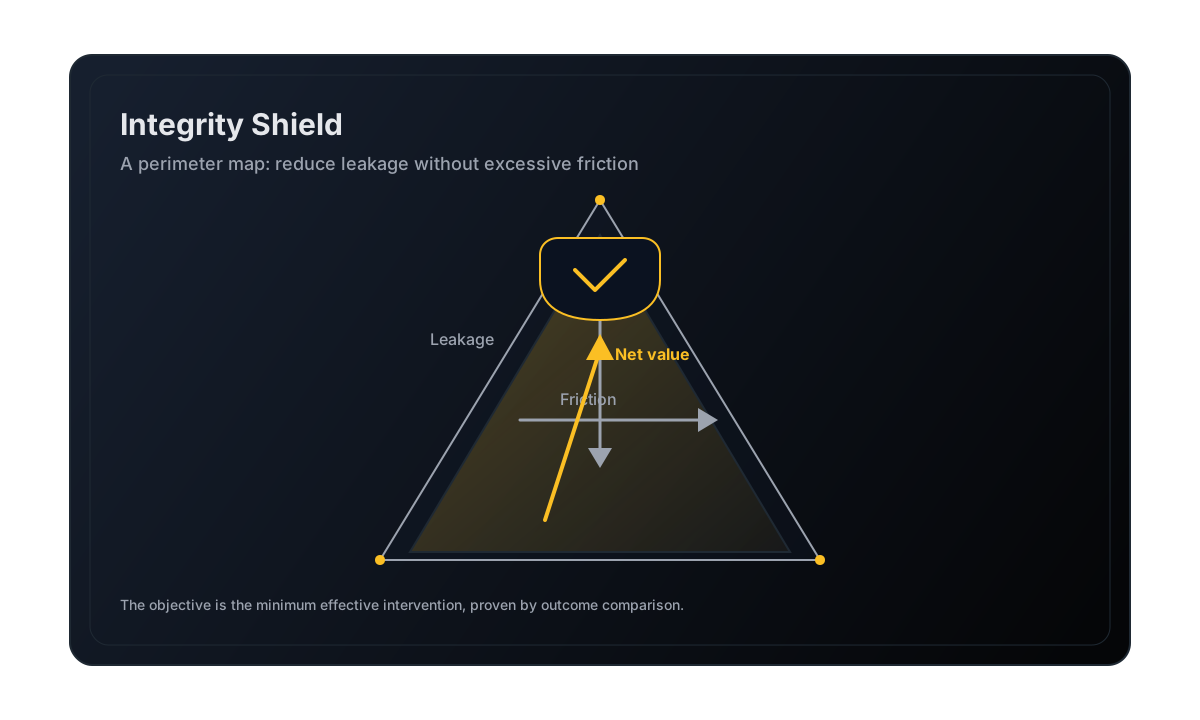
The frontier: reduce leakage while avoiding false friction. Net value rises when the right action is applied at the right moment.
The perimeter problem
As lenders digitise and expand distribution, risk does not only arrive as credit loss. It arrives as leakage: avoidable losses, disputes, operational rework, and process weaknesses that quietly compound. The instinctive response is to “tighten controls” everywhere. That creates a different leak: good customers drop off, teams build workarounds, and the institution pays a hidden tax in conversion and velocity.
The Integrity Shield is designed to keep both truths visible at the same time: the institution must reduce leakage, and it must protect clean flow. The goal is not more checks. The goal is minimum effective intervention.
From risk scoring to action choice
Many organisations treat a risk score as if it were a policy. It isn’t. A score is a signal; a policy is a decision. Integrity Shield separates two questions that are often conflated:
- How risky does this case look? (signal)
- What action is economically best right now? (intervention)
When these are separated, leadership gets a calmer operating posture: the institution can be strict where it pays, and fast where it is safe.
The action ladder
Integrity Shield works through an action ladder: a tiered menu of interventions from low-friction to high-friction, chosen with intent rather than habit.
- Low-friction – silent validation steps, routing improvements, and targeted verification.
- Medium-friction – step-up requirements or short holds when uncertainty is high.
- High-friction – manual escalation or hard stops reserved for narrow, governed patterns.
The ladder matters because it prevents policy drift. Without a ladder, every team creates its own “default tightening”, and the perimeter becomes inconsistent across branches, partners and time.
Measurement-first, not theatre
Controls that cannot be measured inevitably become theatre. Integrity Shield therefore starts with a simple rule: interventions must be compared against a credible baseline. In practice, this means structured pilot lanes and “lane rotation” designs where feasible, so leadership can see net value: leakage reduced and unnecessary friction avoided.
This also makes governance easier. When outcomes are tracked by intervention type, the board can ask a single clean question: “Which actions are earning their right to exist?”
Where it fits in your lending system
Integrity Shield sits at the edges where small issues become expensive when repeated at scale:
- Origination – the smallest additional step that reduces avoidable leakage.
- Disbursal – readiness checks that reduce returns, retries, and operational rework.
- Servicing – dispute prevention and early warning signals before they become escalations.
- Governance – reason codes, audit trails, and review cadence to prevent silent drift.
Typical engagement cadence
- Mapping – identify the perimeter decisions and the current friction hotspots.
- Ladder – define the action ladder and the reason-code vocabulary.
- Pilot lanes – compare interventions safely and measure net value.
- Scale – standardise the winning actions and the monitoring rhythm.
This page describes capability and operating posture. If later you want programmatic execution, the same ladder and measurement spine can be operationalised. The discipline comes first.
Method note
Pearl-style causal graphs guide our work: we quantify what actions change, not merely what risk predicts.
Key terms on this page
- Leakage
- Avoidable loss and rework at the perimeter: disputes, retries, operational escalations, and preventable process weaknesses that quietly compound.
- Friction
- Customer and operational cost introduced by interventions: extra steps, delays, manual handling and drop-offs.
- Minimum effective intervention
- The smallest action that meaningfully reduces leakage while protecting clean flow and conversion.
- Action ladder
- A tiered menu of interventions, from low-friction to high-friction, chosen deliberately and governed with reason codes.