
Collections Lift
Collections Lift is the discipline of turning delinquency from a blunt response into a mapped landscape of frictions. Rather than “chasing dues harder”, the institution separates product misfit, cash-flow stress and execution gaps – and chooses its interventions accordingly.
Collections lift comes from removing friction before it becomes delinquency: signal → nudge → treatment → cure loop.
Why collections deserves its own chapter
In many portfolios, collections is treated as a downstream problem: something that begins once an account has already “gone bad”. Targets revolve around buckets, roll rates and recoveries. Levers are framed in terms of contact intensity, legal action and write-offs.
What this misses is that delinquency is not a single phenomenon. Some customers are in temporary cash-flow trouble. Others are in structural difficulty that no short-term arrangement can fix. Still others are reacting to product misfit, operational errors or a prior experience of being treated poorly. Applying the same script to all three confuses firmness with effectiveness.
Collections Lift recognises that a lender’s reputation is often written in its worst fifteen minutes with a stressed customer. It asks: how do we design those fifteen minutes so that recovery, fairness and long-term franchise value pull in the same direction as far as possible?
A friction map instead of a bucket list
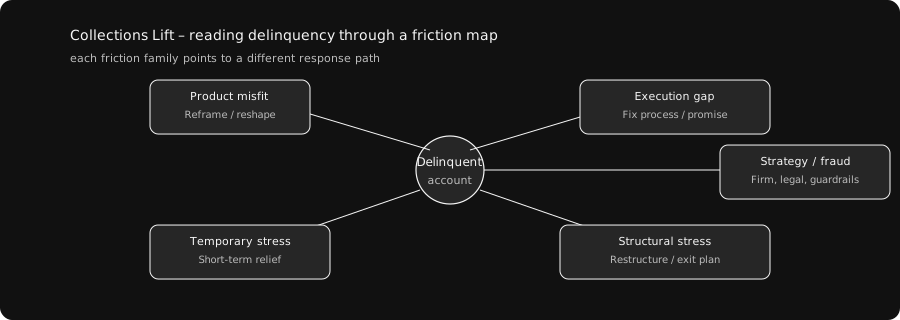
The starting point is a different picture of delinquency. Instead of beginning with ageing buckets, we begin with a friction map – a working taxonomy of why customers fall behind and how they respond to contact.
Typical friction families include:
- Product misfit – term, EMI or structure poorly aligned to the borrower’s cash-flow cycle from the outset.
- Execution gaps – disputes, errors, unposted payments, communication failures or misunderstandings about terms.
- Temporary stress – short-lived shocks such as medical events, job changes or seasonal income dips where the underlying business or household is sound.
- Structural stress – deeper problems in income, business model or leverage that are unlikely to resolve without a more fundamental restructuring.
- Strategic default and fraud – cases where intent is misaligned from the start.
The learning layer uses behaviour, contact outcomes and recovery patterns to gradually populate this map. Over time, the institution can see not just how many accounts are overdue, but which kinds of friction dominate in each segment and vintage.
Matching responses to frictions
Once frictions are better understood, Collections Lift designs a set of response paths. Instead of a single collections script, there is a small menu of calibrated approaches:
- For product misfit, the emphasis is on re-framing the obligation: restructuring, tenor changes or aligned EMI dates that make the debt liveable while preserving discipline.
- For execution gaps, the priority is to resolve the institution’s own errors quickly, restore trust and normalise payments, rather than escalating pressure.
- For temporary stress, short-term arrangements and payment plans that protect both the customer’s dignity and the lender’s recovery prospects.
- For structural stress, early, honest conversations about longer-term solutions, sometimes including deeper restructuring or, in rare cases, an orderly exit.
- For strategic default and fraud, a firmer path with appropriate legal escalation.
The aim is not to create complexity for its own sake. It is to avoid the false economy of treating all delinquency as identical when the underlying stories are different.
Where the learning layer fits
Collections Lift relies on the same learning layer that supports revival and pricing. Every contact attempt, promise, broken promise, cure and write-off is treated as data about which combinations of script, channel, timing and offer work for which frictions.
- The system learns which customers respond best to early, empathetic contact and which require firmer escalation.
- It observes how different restructuring options perform through time, segment and cycle.
- It tracks how changes upstream – in pricing, underwriting or product design – influence the mix of frictions downstream.
Over time, this creates a feedback loop: decisions earlier in the life cycle can be evaluated partly by the kind of collections effort they later require.
Linkage with Stress Navigation and pricing
Collections Lift is closely linked to Stress Navigation and Rates & Pricing Dynamics.
- When the book is in the comfort zone, there is more room for experimental paths that trade some short-term recovery speed for long-term relationship value.
- In the watch zone, experiments become more selective, focusing on segments where evidence suggests a good return on effort.
- In the action zone, discipline tightens; the priority shifts to protecting the balance sheet while still avoiding unnecessary damage to the franchise.
Pricing decisions also matter. Segments consistently originated at the very top of their price bands may show different delinquency and cure patterns from those priced more moderately. The learning layer is explicit about these linkages so that pricing and collections do not work at cross purposes.
Measuring lift, not just effort
Collections performance is often summarised in terms of roll rates and recoveries. Collections Lift keeps those metrics but adds a sharper focus on lift: what improvement a given strategy delivers over a realistic baseline.
Typical measures include:
- Improvement in cure rates for specific segments after introducing new paths or scripts, versus historical cohorts.
- Changes in recovery timing – how fast cash flows return – and what that implies for funding and capital usage.
- Reductions in repeat delinquency and roll-forward into harder buckets for customers who have gone through redesigned paths.
- Qualitative indicators of franchise health in collections: complaint patterns, escalations and regulator feedback.
These lenses allow leadership to ask not just “Are we working hard enough in collections?” but “Which parts of our effort genuinely change outcomes?”
Governance and tone
The tone of collections work is as important as its mechanics. In many institutions, collectors are asked to carry contradictory instructions: maximise recovery, minimise complaints, experiment with new approaches, but avoid visible deviations from standard practice.
Collections Lift addresses this through explicit governance:
- A clear articulation of what respectful, firm contact looks like, and where the institution draws its own red lines.
- Defined pilots and scale-up criteria for new strategies, so that frontline teams are not exposed to accusations of “going off script” when they are in fact executing agreed experiments.
- Structured feedback loops from collectors, complaint channels and customers into product and policy forums.
The result is a practice where collections professionals are not merely enforcing outcomes but contributing actively to the institution’s understanding of its borrowers.
If you only have twenty minutes
For a fast read of this chapter, three questions matter most:
- Do we have a friction map – however simple – that goes beyond buckets and roll rates to explain why customers fall behind?
- Do we have more than one designed path through delinquency, matched to different frictions and anchored in the Stress Navigation zones?
- Can we show, with data, which parts of our collections effort create true lift and which are simply activity?
If the answer to any of these is uncertain, there is likely room to improve both recovery and reputation simply by organising what you already know into a more deliberate practice. Collections Lift is that organising frame.
Key terms in this chapter
- Collections Lift
- The improvement in recovery, cure and long-term behaviour achieved by designed strategies, over and above a realistic baseline of effort.
- Friction map
- A structured view of the main reasons customers fall behind – product misfit, execution gaps, temporary and structural stress, strategic default and fraud.
- Response path
- A designed combination of script, channel, timing and offer matched to a particular family of frictions.
- Repeat delinquency
- A pattern where customers cure and then fall back into delinquency, signalling that deeper issues remain unresolved.
- Collections tone
- The institution’s explicit stance on how it treats customers in difficulty – firm, respectful and consistent with long-term franchise value.