
False Negative Revival
False negatives are applicants the institution declined who would quietly have become some of the best borrowers on the book. This chapter turns that uncomfortable idea into a governed practice: narrow corridors where “no” can safely become “yes, on these terms” inside your declared risk appetite.
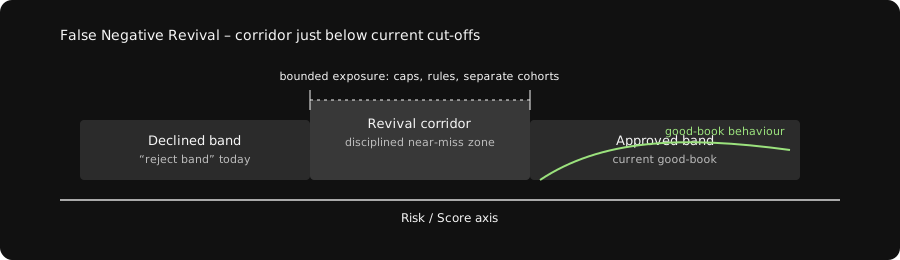
A corridor turns borderline declines into governed approvals: narrow entry patterns, altered terms, capacity bands, and auto-exit guardrails.
What we mean by false negatives
In this notebook, a false negative is not a philosophical concept. It is a very specific economic animal: a declined application that, had it been approved on sensible terms, would have performed at least as well as your core good-book borrowers. It sits in the twilight zone between your current rules and your actual risk appetite.
Typical examples include:
- A salaried borrower with a stable job whose bureau score is a few points below a conservative cut-off.
- A geography that was de-prioritised after an old product misfired, even though current demand and behaviour look different.
- Thin-file customers whose only sin is that your documentation rules were written for the worst five percent of cases and applied to the other ninety-five.
None of these are obvious “should approve” cases. That is exactly why they accumulate quietly. They are individually explainable and collectively expensive.
Where false negatives hide in your process
False negatives do not announce themselves in a single report. They hide in combinations of fields and decisions:
- Cut-off zones – ranges just below score thresholds, income filters, age bands or tenure rules where performance often changes gradually, not abruptly.
- Documentation led declines – cases declined on documentation or “insufficient data” where the behavioural risk was never really assessed.
- Over-generalised policies – rules written after a true problem in one segment, then quietly applied to adjacent segments that do not share the same risk drivers.
AltVector’s learning layer reads these patterns as hypotheses, not verdicts. The question is never “Were we wrong?” in a moral sense. It is “Where are we cutting so bluntly that we are throwing away safe, profitable borrowers along with the genuinely risky ones?”
From borderline cases to revival corridors
The traditional way to handle borderline cases is informal: escalation, persuasion, exception approvals. Over time this corrodes both governance and economics. Good cases depend on persuasive individuals; bad cases sneak through the same channel.
This notebook uses a different construct: the revival corridor. A corridor is a narrow, explicitly defined band along your decline–approve boundary where a distinct decision logic is allowed under strict capacity limits and guardrails.
A revival corridor is defined by four elements:
- Entry pattern – a precise description of which declines are eligible: for example, “salaried, score 10–20 points below cut-off, bureau clean on serious delinquencies, urban salaried locations only”.
- Altered terms – the rate, tenor, ticket size or collateral configuration under which you are willing to say “yes” while staying within appetite.
- Capacity band – how many such cases you will allow in a month or quarter, and what exposure cap applies by segment or geography.
- Guardrails and exit rules – early warning indicators and performance thresholds that trigger slowdown, pause or shutdown of the corridor.
Once written down in this way, revival stops being a matter of personality and becomes a matter of design.
Designing corridors inside your risk appetite
Revival is only legitimate if it lives inside your declared risk appetite. The learning layer therefore connects corridor design directly to stress views and capital comfort:
- Expected loss and stress loss for revived cohorts are benchmarked against adjacent good-book segments.
- Pricing and term adjustments are calibrated so that revived cohorts target at least the same risk-adjusted return on capital as the core book.
- Capacity bands are sized so that even a poor outcome in a corridor does not threaten institutional stability; it remains a contained experiment.
In practice, this means the board can be shown a simple picture: where corridors sit relative to comfort, watch and action zones, and what happens automatically if performance drifts.
How the revival engine operates day to day
Operationally, False Negative Revival is a thin additional layer on top of your existing origination flow.
- Declined applications are scored through an additional lens to check whether they match any active revival corridor entry pattern.
- If they do, they are re-evaluated under the corridor’s altered terms and quality gates. Approved cases are tagged as “revived” in downstream systems.
- If they do not, they remain standard declines; no additional handling is required.
There is no need for manual hunting through past declines. The learning layer simply ensures that when a near-miss pattern appears, the institution recognises it and routes the case through a pre-defined, governed corridor.
Measuring what revival is doing to your book
A revival programme that cannot be explained in numbers will not survive contact with a stressed quarter. The notebook therefore insists on a small, disciplined scorecard:
- Volume and share of originations coming through each corridor, versus capacity bands.
- Early vintage behaviour – roll rates, buckets, cure rates – of revived cohorts versus matched vanilla cohorts.
- Yield and risk-adjusted income contribution of revived cohorts, after funding and expected loss.
- Impact on addressable market in priority segments: how many otherwise-lost customers are being brought into the franchise.
These metrics are designed to be board-ready. They allow leadership to ask: “Is revival behaving as designed? Are we being paid adequately for the additional complexity? Where should we graduate, resize or shut corridors?”
Governance, ownership and escalation
Revival corridors live at the intersection of Risk, Business and Finance. In most institutions, a small joint cell owns the design. Approvals for new corridors and significant changes follow the same cadence and discipline as policy changes.
The escalation paths are written down before corridors go live:
- What happens if a corridor breaches its guardrails – who is notified, who can pause it, who can restart it?
- Under what conditions can capacity bands be raised – what evidence is required from the learning layer?
- How often does the institution re-open the question of which decline patterns deserve a corridor and which do not?
This design keeps the tone of the conversation where it belongs: not “Were we brave enough?” but “Were we disciplined enough to learn in the right places?”
If you only have twenty minutes
If you have limited time for this chapter, focus on three ideas:
- False negatives are not a moral failure; they are a signal that your rules are coarser than your appetite. Identifying them is an efficiency gain, not a gamble.
- Revival corridors turn informal exceptions into designed experiments with explicit terms, capacity bands and guardrails.
- The learning layer makes revival self-respecting: each corridor is born with a hypothesis, a stop-loss and a way to graduate or shut down.
Once these three points are understood, the rest of the chapter is detail. The key question for leadership becomes: “Where, exactly, are we willing to open our first corridor – and what will we require from it to call it a success?”
Key terms in this chapter
- False negative
- A declined application that, had it been approved on sensible terms, would have behaved like a core good-book borrower.
- Revival corridor
- A narrow, explicitly defined band along the decline–approve boundary where alternative terms and decision logic are allowed under strict guardrails.
- Capacity band
- The pre-agreed volume and exposure limits for a corridor, sized so that even poor outcomes do not threaten institutional stability.
- Quality gate
- A set of additional checks specific to revived cases – for example, employment verification or bureau cleanliness – used to keep corridor risk aligned with appetite.
- Guardrails
- Explicit numerical limits and performance thresholds that trigger automatic slowdown, pause or closure of a corridor.