
Rates & Pricing Dynamics
This chapter treats price as a designed surface, not a table of numbers. Rates & Pricing Dynamics connects who you lend to and how you steer under stress with the terms on which you are willing to carry that risk, segment by segment.
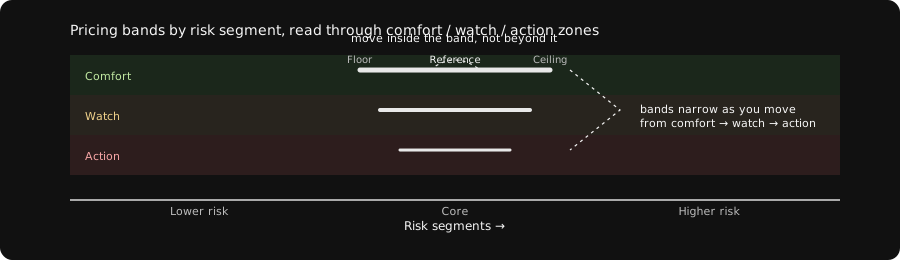
Price bands are not “rates in a spreadsheet”; they are controlled levers that shift demand, risk, and portfolio shape together.
What we mean by rates and pricing
In day-to-day conversation, “rate” and “price” are often used interchangeably. In this notebook they are related but distinct. The rate is the nominal interest percentage. The price is the full economic package: rate, tenor, fees, insurance, collateral conditions, grace structures and the way all of these interact with funding and expected loss.
When we talk about Rates & Pricing Dynamics, we mean three things at once:
- How the institution sets and adjusts rate bands for different risk and product segments.
- How the broader price package moves with those bands – including insurance premiums and fees.
- How these movements behave through time, especially under changing stress and competitive conditions.
The aim is not to chase the last basis point of margin in isolation. It is to make sure that the terms on which you grow are coherent with your appetite, your funding reality and your long-term franchise.
Why static grids are no longer enough
Many institutions still rely on static rate grids – broad policy tables that combine product, bureau band and a handful of other fields into a small set of allowed rates. These tables are easy to communicate, but they age quickly. Behaviour shifts, funding costs move, and competitors quietly redraw the map.
The result is a familiar pattern:
- In some segments you are over-pricing, leaving resilient borrowers to be picked up by more agile competitors.
- In others you are under-pricing, paying more in expected loss than you recover in yield – effectively subsidising the riskiest slivers of the book.
- Experimentation happens through ad-hoc deviations and special schemes whose long-term consequences are rarely measured cleanly.
Rates & Pricing Dynamics offers a different posture: treat the grid as a living object, updated deliberately in response to what the learning layer observes about behaviour and stress.
Price bands instead of single points
A core construct in this chapter is the price band. Instead of asking “What is the right rate for this segment?”, we ask “What is the sensible band within which we can move, and how do we decide where to sit inside that band today?”
Each band is defined by three anchors:
- A floor below which the risk-adjusted return does not justify the exposure, once funding and stress are considered.
- A ceiling above which take-up, fairness concerns or long-term franchise value begin to deteriorate meaningfully.
- A reference point – often the mid-point – where the institution expects to sit in neutral conditions.
The Adaptive Layer then uses observed responses – approval behaviour, take-up rates, early delinquency, prepayment and refinance patterns – to suggest where inside each band you should be in a given zone of the stress map.
Designing bands inside appetite and competition
Designing price bands is not an abstract exercise. It sits at the intersection of three views:
- Risk view – the expected loss and stress loss profile of the segment, anchored in the same language used in Stress Navigation.
- Demand view – how sensitive volume and quality are to changes in rate and price, for different borrower types and ticket sizes.
- Competitive view – where peers are priced today, and how your franchise is positioned relative to them.
AltVector’s practice treats these as inputs to a disciplined discussion, not as an algorithmic verdict. The outcome is a set of bands by segment that leadership can endorse, with a clear understanding of where growth is being bought, where it is being declined and why.
How the pricing engine operates day to day
Operationally, the pricing engine is a thin layer on top of your existing decision stack. It does not replace your underwriting models or policy rules. It translates their outputs into rates and price packages inside the agreed bands.
- For each incoming application, the engine identifies the relevant segment and associated price band.
- It reads the current zone from the Stress Navigation map – comfort, watch or action – and adjusts the position within the band accordingly.
- It incorporates any active revival corridors or insurance configurations, ensuring that revived and protected segments are priced in line with appetite.
Over time, the engine becomes a source of quiet discipline. Exceptions do not disappear, but they become traceable deviations from a known band, rather than one-off gestures that the institution forgets.
Linking pricing to revival, collections and insurance
Rates & Pricing Dynamics is tightly coupled with other chapters in this notebook.
- False Negative Revival relies on price to reshape risk: revived borrowers may carry a slightly higher rate or tighter terms, but always within a band that keeps them aligned with appetite and stress views.
- Collections Lift reads pricing decisions when interpreting delinquency: it matters whether a stressed cohort was aggressively priced at the top of the band or offered more balanced terms.
- Insurance Pricing – Term Life shares the same discipline: premiums and benefits are organised into bands that respect both risk and fairness over longer horizons.
The learning layer keeps a longitudinal trace: which combinations of rate, fee, tenor and insurance produced resilient, mutually sustainable relationships – and which combinations the institution should quietly retire.
Measuring what pricing is doing to your book
A pricing discipline that cannot be described in numbers will quickly devolve into a collection of anecdotes. The notebook therefore encourages a compact, recurring measurement frame:
- Yield and spread by segment, net of funding and expected loss, relative to internal targets and stress views.
- Take-up and mix – how volumes and customer profiles change as you move within bands, including substitution between products and channels.
- Behaviour under stress – delinquency, prepayment and refinance patterns for cohorts originated at different points within their bands.
- Fairness and franchise indicators – early signals such as complaint patterns, unusual churn in specific segments, or regulator feedback that suggest a band is being pushed too hard.
These measures help leadership see price not as a tactical lever pulled in isolation, but as a structural determinant of which customers you attract, how they behave and how your book survives stress.
Governance, ownership and revision
Rates & Pricing Dynamics, like revival and stress, lives at the junction of Risk, Business and Finance. A small cross-functional cell typically owns the framework, while formal authority for changes rests with existing pricing and product forums.
The key is to avoid two extremes: a grid that never moves, and a grid that is rewritten every quarter in response to short-term pressure. The learning layer provides a middle path: revisions are proposed when evidence accumulates, zones shift or strategy genuinely changes – and each revision is recorded with a clear rationale.
Over time, this builds a memory of how the institution’s price posture has evolved, and why. That memory is often as valuable as the current bands themselves, especially when leadership or external conditions change.
If you only have twenty minutes
For a quick read of this chapter, three questions frame the essence:
- Do we think in terms of price bands – floors, ceilings and reference points – or are we still managing the book through isolated rate points and schemes?
- Do our bands know how to respond when the Stress Navigation map moves from comfort to watch or action?
- Can we show, with a small set of metrics, how our pricing posture has influenced who we attract, how they behave and how the book holds up under stress?
If the answer to these questions is unclear, there is likely hidden room to lend more, risk less simply by bringing more structure to price. AltVector’s role is to make that structure explicit, breathable and numerate.
Key terms in this chapter
- Price band
- A range of economically sensible terms – defined by a floor, ceiling and reference point – within which the institution can move for a given segment.
- Floor and ceiling
- The lower and upper boundaries of a price band, below or above which risk-adjusted return, take-up or franchise health deteriorate.
- Reference point
- The rate or price configuration where the institution expects to sit in neutral conditions, absent unusual stress or competitive pressure.
- Elastic segment
- A borrower group whose volumes or behaviour are noticeably sensitive to changes in rate or price within the band.
- Pricing engine
- The layer that translates risk, stress and strategy inputs into concrete terms for each application, inside the agreed bands.