
Stress Navigation
Stress Navigation is the way the institution moves through changing conditions without lurching from over-confidence to panic. This chapter links your everyday levers – revival, pricing, collections and insurance – to a simple, continuous map of comfort, watch and action zones.
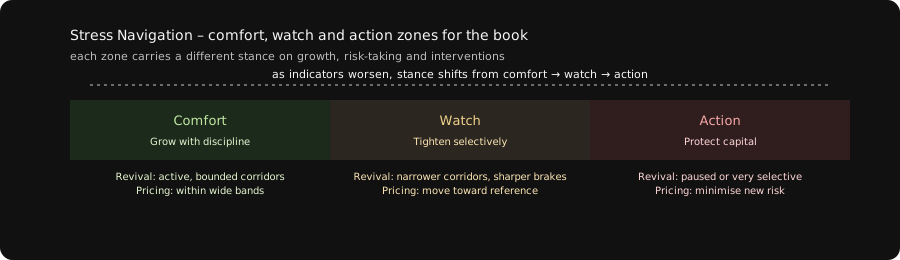
Stress navigation draws three operating zones—comfort, watch, action—so policies adapt before losses snowball.
From stress testing to stress navigation
Traditional stress testing is episodic. Once or twice a year, the institution runs heavy scenarios, produces thick decks, and reassures itself that capital is adequate under severe but plausible conditions. Useful as that is, it often leaves a gap: how should day-to-day decisions behave between those exercises?
Stress Navigation treats stress not as a periodic inspection, but as a continuous background condition. The question shifts from “Are we capital-adequate under Scenario X?” to “Given where we are on the cycle map today, how much room do we have to experiment with revival, pricing or collections without betraying our stated resilience?”
The answer is expressed, not in abstract language, but in zones: comfort, watch and action – for the book as a whole and, where needed, for particularly sensitive segments.
Comfort, watch and action zones
The learning layer represents stress through three working zones:
- Comfort zone – where capital, liquidity and early delinquency behave within agreed bands and there is headroom to expand corridors, open new price bands or test more generous terms for specific segments.
- Watch zone – where warning indicators are elevated but not yet critical: roll rates tick up, certain vintages perform below plan, or macro signals suggest tightening ahead. The priority shifts to refinement, not expansion.
- Action zone – where one or more indicators cross explicit triggers: stress losses approach board tolerance, liquidity buffers tighten, or specific cohorts deteriorate sharply. Here the mandate is to protect resilience first and treat growth experiments as discretionary.
These zones are not defined by mood. They are built around a short list of metrics the board recognises: capital coverage, stress loss ratios, delinquency and cure in key segments, funding conditions.
Linking levers to zones
Stress Navigation is only useful if it actually influences decisions. The notebook therefore ties each major lever to the zone map in advance, not in the heat of a crisis.
- In the comfort zone, revival corridors can be opened or scaled carefully, price bands can be widened, and collection strategies can include more accommodative paths for temporary stress.
- In the watch zone, the focus is on sharpening: corridors are reviewed for performance, capacity bands are kept flat or trimmed, and new experiments are introduced selectively with tighter guardrails and more frequent reviews.
- In the action zone, expansionary moves pause. Certain corridors are put on hold, pricing becomes more conservative at the margin, and collection intensity is tuned to protect recovery without damaging long-term franchise value.
The point is not to script every response. It is to ensure that when the zone changes, the institution already knows which levers are expected to move, in which direction, and who is accountable.
Designing the stress dashboard
Underneath the simple language of zones sits a compact stress dashboard. AltVector’s practice keeps this intentionally small. The goal is not to overwhelm executives with charts; it is to provide a stable, recurring view that they can internalise.
A typical Stress Navigation dashboard will include:
- Capital and buffer indicators – distance to internal and regulatory minima, shown under baseline and calibrated stress views.
- Delinquency and loss indicators – roll rates, cure rates and loss patterns by major product and cohort, including revived cases as a distinct line of sight.
- Flow from experiments – contribution of corridors, new price bands and collections strategies to volumes, income and stress losses.
- External signals – a short list of monotoring points: macro indicators, market spreads, regulatory guidance that might change how the institution reads its own numbers.
The learning layer updates this view on a regular cadence, but the design changes slowly. Familiarity is a feature, not a bug.
Stress Navigation and the other chapters
Stress Navigation is not a parallel activity. It is the context in which the other chapters are allowed to operate.
- False Negative Revival uses the zone map to size and pace corridors. In the comfort zone, corridors may expand within guardrails; in the action zone, their capacity bands tighten or pause.
- Rates & Pricing Dynamics uses the map to decide where the institution can afford to be more generous, and where it must reinforce pricing discipline.
- Collections Lift uses it to balance firmness and forbearance: when and where to offer restructuring or softer contact paths, and when to protect the book more assertively.
- Insurance Pricing – Term Life interprets stress not only as a default story but as a persistency and claims story over longer horizons.
- The Adaptive Layer and ROI Lens ensure that changes justified by the zone map are logged and evaluated, so that the institution learns how its own book behaves across cycles.
In this way, Stress Navigation becomes the quiet backbone of the practice: the shared frame that keeps separate levers from pulling the institution in contradictory directions.
Cadence, ownership and decision theatre
A Stress Navigation view is only as good as its cadence and ownership. In most institutions, the work sits with a small cross-functional cell anchored in Risk and Finance, with Business as an active partner.
The cadence is simple:
- A regular working review where the cell updates the dashboard, reclassifies zones where needed and prepares recommendations on corridors, pricing moves and collection strategies.
- A standing slot in senior forums where those recommendations are discussed, accepted, modified or rejected explicitly.
- A written trace of what was decided and why, so that future quarters can be read against the intentions of the time rather than reconstructed from memory.
This is how Stress Navigation avoids becoming decision theatre – a set of impressive charts that do not change behaviour. Each shift in zone carries a proposed set of moves on named levers, with clear owners.
If you only have twenty minutes
If you are coming to this chapter with limited time, three questions matter most:
- Do we have a simple, agreed map of comfort, watch and action zones that connects stress views to our appetite and capital?
- Do our lending levers – revival, pricing, collections, insurance – know what they are expected to do when the zone changes?
- Is there a small, recurring forum where those expectations are checked against reality and adjusted?
If the answer to any of these is “no”, Stress Navigation is likely to live in slides rather than in behaviour. AltVector’s practice exists to close that gap, so that lending decisions remain explainable even when the environment stops behaving politely.
Key terms in this chapter
- Stress Navigation
- A continuous approach to reading and responding to stress, where lending levers are tied explicitly to comfort, watch and action zones.
- Comfort zone
- Conditions under which capital, delinquency and external signals sit within agreed bands, leaving room for carefully governed growth experiments.
- Watch zone
- A state where early warning indicators are elevated but not yet critical, calling for refinement rather than expansion.
- Action zone
- A state where explicit triggers are breached and the institution prioritises resilience, pausing or tightening growth levers.
- Stress dashboard
- A compact, recurring set of metrics that connects stress views to concrete decisions on corridors, pricing, collections and insurance.