
Terminology
This section gathers the vocabulary used across the Practice Notebook into one place. It is not a legal glossary. It is a working map of the phrases AltVector uses when reading a lending and protection book through a cause–effect lens.
Core lending and risk terms
- False Negative
- An application that was declined under existing rules or models but, with the benefit of hindsight, would have behaved like a good-book borrower. False Negative work is about identifying and reviving such cases in a controlled way, not about relaxing standards in general.
- Revival corridor
- A deliberately defined zone just below existing approval cut-offs where additional review and alternative structures are allowed. Corridors are bounded in volume and monitored separately so that revival does not quietly turn into general loosening.
- Good-book behaviour
- The observed pattern of repayment, usage and delinquency for borrowers the institution is happy to have in its portfolio over time. It is the reference against which revived or newly targeted segments are compared.
- Friction map
- A structured view of the main reasons customers fall behind or complain: product misfit, execution gaps, temporary and structural stress, strategic default and fraud. Collections strategies are designed against this map rather than against buckets alone.
- Response path
- A designed combination of script, channel, timing and offer matched to a particular family of frictions in collections. Different paths exist for temporary stress, structural issues, disputes and deliberate default.
- Integrity Shield
- A perimeter discipline for reducing avoidable leakage without creating unnecessary friction for clean customers. It separates “risk signals” from “action choice”, using a tiered action ladder and outcome comparison so interventions earn their right to exist.
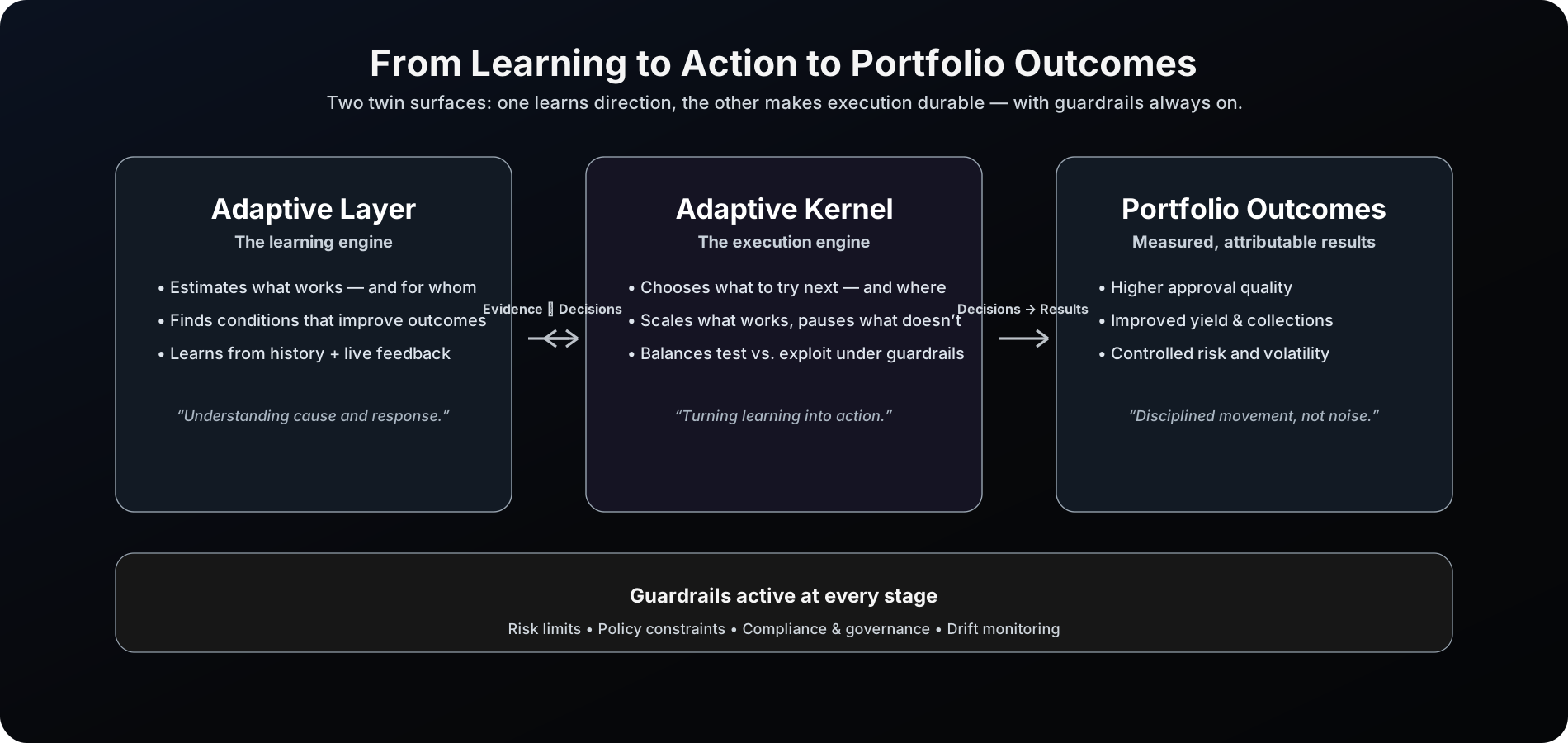
Learning (Adaptive Layer) → decisions (Adaptive Kernel) → outcomes — with guardrails always on.
Adaptive system terms
- Adaptive Layer
- The learning engine. It estimates what works, for whom, and under what conditions — so decisions are driven by evidence, not gut-feel.
- Adaptive Kernel
- The on-field decision engine. It chooses what to try next, where to scale, and where to stop — using live portfolio feedback. It balances “exploit what works” with “test what could work better,” always under guardrails.
Pricing and stress navigation terms
- Price band
- A range of economically acceptable prices for a given risk profile. Each band has a floor, a ceiling and a reference point. The institution moves within this band in response to observed behaviour, competition and stress, rather than relying on a single static price.
- Floor and ceiling (pricing)
- The floor is the lowest price at which, after funding and expected loss, the portfolio remains sustainable within appetite. The ceiling is the highest price beyond which fairness, take-up or long-term franchise value are judged to be at risk.
- Stress Navigation map
- A simple, shared view of the book’s condition across three zones – comfort, watch and action. Each zone has associated expectations for growth, risk-taking and interventions so that responses to stress are deliberate rather than improvised.
- Comfort, watch and action zones
- Comfort is where observed behaviour and leading indicators sit well within appetite; watch is where trends warrant closer attention and selective tightening; action is where decisive measures are needed to protect capital and liquidity.
Collections and protection terms
- Collections Lift
- The improvement in cure, recovery and long-term behaviour delivered by designed collections strategies, measured against a realistic baseline of effort. Lift is about the difference made by deliberate design, not about total activity.
- Repeat delinquency
- A pattern where customers cure and then fall back into delinquency. It is a signal that deeper issues – such as structural stress or product misfit – remain unresolved.
- Collections tone
- The institution’s explicit stance on how it treats customers in difficulty – firm, respectful and consistent with its long-term franchise. Tone is expressed in scripts, escalation rules and how exceptions are handled.
- Premium band (term life)
- The protection analogue of a price band: a range of acceptable premiums for a given risk profile, bounded by a sustainability floor and a fairness ceiling, with a reference premium under neutral conditions.
- Embedded protection
- Term life cover that is sold as part of, or alongside, a lending product. Embedded protection affects both insurance economics and credit behaviour, and is therefore read jointly.
- Protection promise
- The practical combination of premiums, benefits, disclosure, service and claims behaviour that customers experience as “being protected”, beyond what is written in policy documents.
Learning and adaptation terms
- Adaptive Layer
- The learning engine that connects signals, levers and outcomes across revival, pricing, collections, insurance and stress. It turns decisions into reusable experience rather than isolated episodes.
- Signals, levers and outcomes
- Signals are what is observed at decision time; levers are the configurable choices the institution makes; outcomes are how borrowers and portfolios behave subsequently. The Adaptive Layer tracks how different combinations relate.
- Strategy variant
- A specific, tagged configuration of levers – such as a corridor definition or price posture – introduced with an explicit hypothesis and exposure limits. Variants are compared with baselines to understand lift and risk.
- Learning loop
- The cycle of proposing a strategy, observing outcomes, comparing them with baselines and refining the design in response. A functioning learning loop turns experiments into a rhythm rather than one-off projects.
- Guardrail
- A predefined limit on exposure, performance or conduct that constrains how far and how fast a strategy may adapt. Guardrails ensure that learning occurs within agreed appetite.
ROI and partner terms
- ROI Lens
- The integrated view that connects strategies in revival, pricing, collections, insurance and adaptation to their contribution in income, loss, resilience and relationship terms, beyond a realistic baseline.
- Contribution story
- A narrative, backed by numbers, describing what a specific strategy added or removed relative to a baseline over an appropriate horizon, rather than focusing on raw metrics alone.
- Baseline
- A realistic reference scenario – often drawn from prior strategies or matched cohorts – that approximates what would likely have happened without a given strategy. Baselines are central to judging lift.
- Counterfactual
- The “what would have happened otherwise” outcome for the same case in a world where a specific decision (or policy) was not applied. It is not directly observed, but it is the reference we need to judge impact: lift is the gap between what happened and its counterfactual.
- Cycle robustness
- The extent to which a strategy’s benefits and risks remain acceptable across comfort, watch and action zones, not only in benign periods.
- Partner Handoff
- The practice of turning lending and protection strategies into a clean, testable interface that partners can integrate with confidence, with clear roles, fallbacks and measurement frames.
- Data contract
- The agreed structure and meaning of the information exchanged between a partner and the service. A good data contract is stable, well-documented and understood by both technology and business teams.
- Fallback path
- The documented way in which decisions continue to be made if an external interface is temporarily unavailable. Fallbacks protect operations while keeping learning transparent.
How to use this terminology
The terms collected here are intended to make conversations faster, not more opaque. Each has a concrete operational meaning and a place in the notebooks’ diagrams. When in doubt, the working test for any new term is simple: can a cross-functional group – risk, business, finance, technology – use it in the same sentence and mean the same thing?
As practices evolve, this list can expand. What matters is not the number of terms but their clarity and the discipline of attaching them to observable patterns in the book. In that sense, the terminology page is itself part of the Adaptive Layer: a living record of how the institution talks about lending more while risking less.