
Insurance Pricing – Term Life
This chapter extends the same learning logic used for lending into term life protection. Instead of treating premiums as a static tariff, Insurance Pricing – Term Life frames them as a set of bands that balance mortality risk, persistency, customer fairness and the long horizon over which trust is earned.
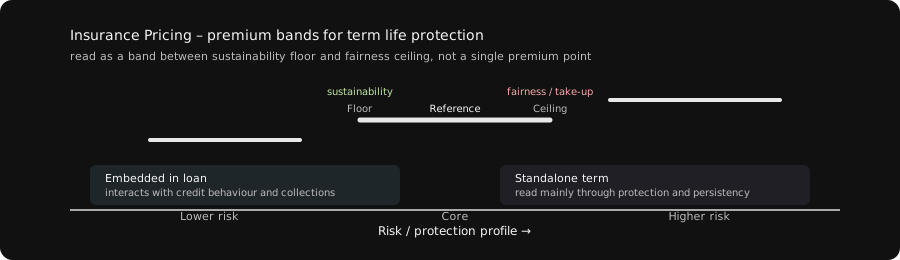
Term-life premium bands can be tuned so protection remains affordable while risk is priced transparently and fairly.
Why term life sits in this notebook
At first glance, term life pricing looks very different from lending. There is no EMI, no delinquency bucket, no collateral. Yet the underlying questions are familiar. Who are we willing to cover, on what terms, and how do those terms behave under stress? How do we ensure that the customers we attract, and the way we serve them, leave the franchise stronger rather than thinner?
Term life protection is often attached to lending journeys: as a cross-sell, a bundle or a comfort element for both borrower and lender. When priced and designed well, it deepens relationships and cushions families against shocks. When priced poorly, it becomes an opaque add-on that erodes trust and invites future complaints.
The purpose of this chapter is not to replicate actuarial models. It is to show how a lender or allied institution can bring the same cause–effect discipline to term life premiums and benefits that it brings to revival, pricing and stress on the credit side.
From flat tables to living bands
Many term portfolios rely on flat pricing tables: age, sum assured, term and a few health categories map to pre-set premiums. These tables are often inherited from product filings and change slowly. Over time, behaviour and expectations evolve: medical understanding improves, income patterns shift, and customers compare offers more actively.
The learning layer encourages a different posture. As with lending, the question becomes: what are sensible premium bands for a given risk profile, and how do we move within those bands as we learn?
Each band is anchored by:
- A floor below which long-term sustainability is at risk once mortality, expense and lapse experience are considered honestly.
- A ceiling above which value-for-money and fairness concerns begin to outweigh the incremental margin, especially for middle-income customers.
- A reference premium where the institution expects to sit under neutral conditions.
Within this structure, pricing is not a one-off filing but a practice that responds to real experience and to the institution’s evolving view of protection as part of its promise to customers.
Key forces: mortality, persistency and behaviour
Three forces dominate the cause–effect story in term life:
- Mortality – the pattern of claims over time, by age, health profile, occupation and geography. Actuarial work anchors this view, but real portfolios always differ from tables in some respect.
- Persistency – how long policies stay in force. Lapses and surrenders matter because acquisition and onboarding costs are front-loaded, while risk and value unfold over years.
- Customer behaviour – how customers respond to premium changes, benefit structures, disclosure requirements and the experience around issuance and claims.
Insurance Pricing – Term Life treats these not as separate analyses but as parts of a single learning loop. The institution observes which combinations of premium, benefit, communication and service attract resilient, long-term customers – and which combinations produce early lapse, grievance or adverse selection.
Designing premium bands with fairness in view
Fairness is not just a regulatory expectation; it is a practical necessity for a protection business that aims to last. Customers will tolerate complexity when they believe the institution is acting within a reasonable corridor of fairness. They rarely forgive opaque add-ons or pricing that seems to punish them for being honest.
The learning layer helps by making fairness discussable:
- It distinguishes segments where higher premiums genuinely reflect higher, well-evidenced risk from segments where premium differences are more a function of legacy tables or distribution habits.
- It highlights where cross-sold cover is consistently priced at the top of bands compared with standalone offers, and what that does to persistency and trust.
- It allows leadership to see how claim experience and complaint patterns align with premium posture across age and income bands.
The outcome is not perfect symmetry. It is a set of premium bands that senior teams can defend in a room full of informed customers without changing the subject.
Embedded cover in lending journeys
When term life is embedded into lending flows, additional cause–effect channels open up. The cover affects more than protection P&L; it also influences credit behaviour and relationship depth.
- For some borrowers, having cover linked to the loan reduces anxiety and stabilises repayment behaviour, especially for families with a single primary earner.
- For others, poorly explained or perceived-expensive cover breeds resentment and can fuel early closures or complaints if circumstances change.
- Claims experience in tough moments shapes how borrowers talk about the institution to their peers.
Insurance Pricing – Term Life therefore asks a dual question: what premium and benefit combinations make sense for the protection line itself, and how do those choices influence the lending relationship and the broader franchise?
Linkage with Stress Navigation and pricing
Term life does not live outside the stress map. In periods of benign conditions and strong capital, there may be room to be more generous on benefits or pricing for certain cohorts, especially where protection plays a stabilising role in credit portfolios. In tighter conditions, the institution may choose to refocus on core customer segments and simpler benefit structures.
Similarly, there is a quiet interaction with Rates & Pricing Dynamics on the lending side:
- Borrowers paying fair, transparent loan pricing are more likely to perceive attached protection as part of a coherent offer rather than as an extraction.
- Conversely, aggressive lending pricing, coupled with opaque protection premiums, can create a sense of being overcharged on all fronts, even if each component is justifiable on paper.
The learning layer keeps these interactions visible so that decisions on term life do not undercut the institution’s efforts to lend more and risk less in responsible ways.
Measuring protection that keeps its promise
Measuring insurance performance purely through short-term profit can lead to perverse decisions. The notebook therefore recommends a small set of measures that reflect the long horizon of protection:
- Persistency and lifetime value by cohort and premium band, not just one-year lapse rates.
- Claims experience versus expectation, including the ease or friction of the claims process as reported by customers and intermediaries.
- Grievance and complaint patterns associated with term products, cross-sold or bundled offers, and how these evolve after pricing or design changes.
- Credit-side impact where cover is linked to loans: differences in repayment stability and retention between protected and unprotected cohorts.
These measures turn the abstract promise of “protection” into something the institution can examine and improve deliberately.
Governance, documentation and communication
Governance in protection is partly technical and partly linguistic. Technical governance ensures that premium bands, underwriting rules and benefit structures match the institution’s risk appetite and regulatory obligations. Linguistic governance ensures that the way products are explained to customers matches what they are likely to understand, not only what is legally minimal.
Insurance Pricing – Term Life therefore emphasises:
- Clear internal documentation of how bands are set, what assumptions they rely on and when they were last reviewed.
- Plain-language communication for customers about what is covered, what is not and what happens if circumstances change.
- Regular forums where protection metrics and stories are read alongside lending metrics, rather than in a different building.
In this way, protection becomes a visible part of the institution’s learning system, not a bolt-on line of business.
If you only have twenty minutes
For a quick conversation on this chapter, three questions frame the essence:
- Do we think of term life premiums as bands anchored in mortality, persistency and fairness, or are we still living entirely inside legacy tables?
- Do we understand how our term pricing and claims behaviour influence our lending relationships and franchise, especially where cover is embedded in loans?
- Can we show, with a small, recurring set of measures, that our protection business is keeping its promise to customers over time, not just producing near-term margin?
If these questions cannot yet be answered calmly, there is room to treat term life not just as a product but as a long-term expression of the institution’s character. The learning layer is there to make that character visible and adjustable.
Key terms in this chapter
- Premium band
- A range of economically and ethically acceptable premiums for a given risk profile, defined by a floor, ceiling and reference premium.
- Persistency
- The pattern of policies remaining in force over time, often measured through multi-year retention rather than single-year lapse alone.
- Adverse selection
- A situation where higher-risk individuals are more likely to buy or retain cover than lower-risk individuals at the same premium, leading to skewed experience.
- Embedded protection
- Term life cover that is sold as part of, or alongside, a lending product rather than on a standalone basis.
- Protection promise
- The practical combination of premium, benefits, disclosure, service and claims behaviour that customers experience as “being protected”.